
In modern modular and panelised construction factories, productivity depends on producing accurate wall, floor, and roof panels at scale. While many manufacturers focus on framing systems and material handling, fastening technology often has the greatest impact on production speed and quality.
One of the most effective solutions is the Screwbridge machine.
A Screwbridge automates the process of fixing boards and sheathing materials to timber or steel frames, delivering faster production rates, greater consistency, and reduced labour requirements compared to manual fastening methods.
What is Screwbridge Machine?
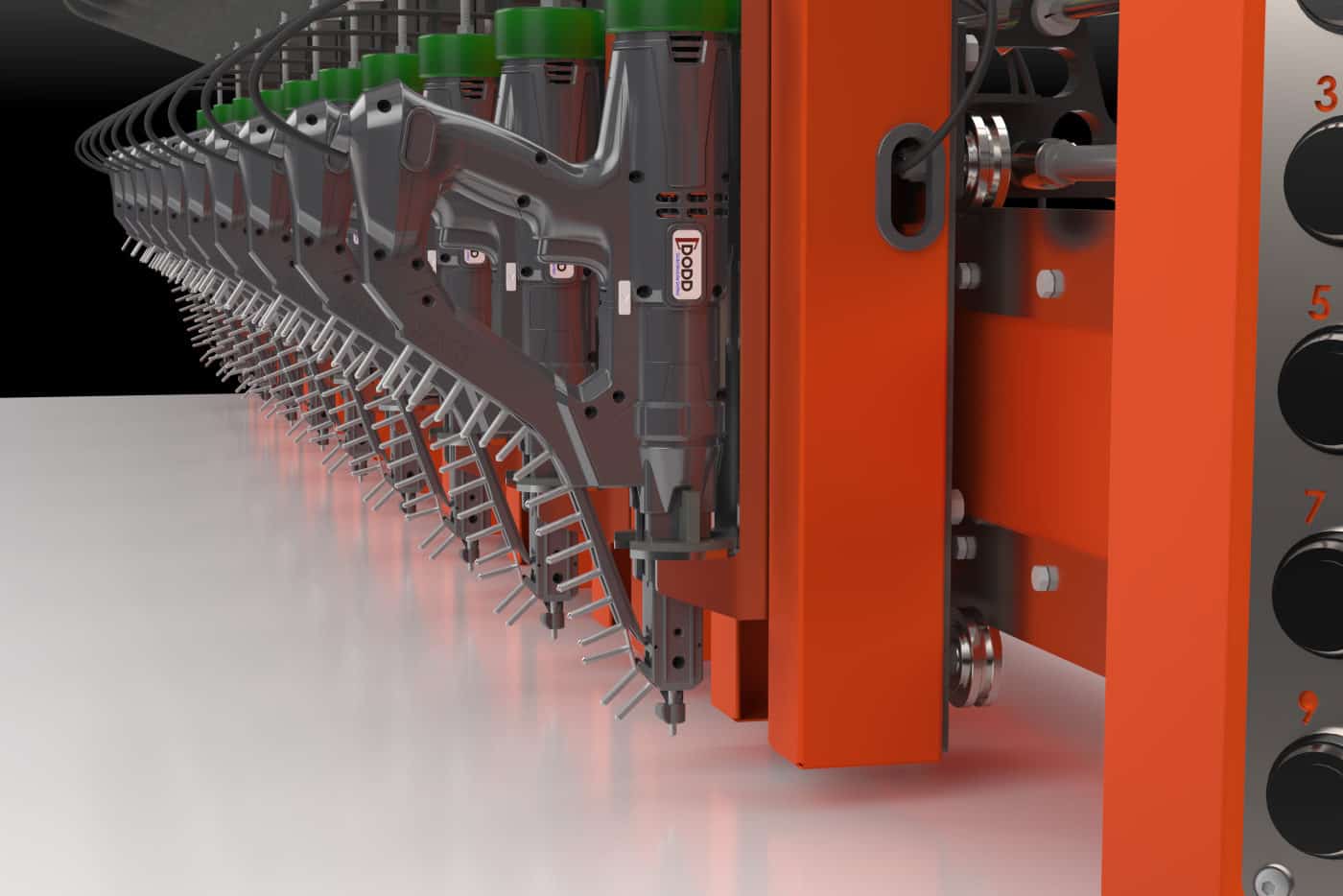
A Screwbridge machine is an automated fastening system that moves across a framed panel and drives screws into predetermined locations.
The machine typically spans the width of the production table, allowing it to travel the full length of the frame while fastening materials onto the frame.
By automating screw placement, manufacturers can achieve precise fixing patterns that are difficult to replicate consistently through manual methods.
How Does a Screwbridge Work?
The process generally follows these stages:
- Frame Assembly – The frame is assembled and ready to be boarded.
- Board Placement – OSB, plywood, cement board, plasterboard, or other sheathing materials are positioned onto the frame. This process can be completed manually; however, Dodd recommends utilising a vacuum lifter for more efficient board placement.
- Positioning & Fastening – The Screwbridge is positioned (manually or powered) where the screws are required. The machine drives screws into the frame at predetermined spacings.
- Quality Verification – Because the screw positions are determined by the machine, fastening consistency is significantly improved compared to manual installation.
The result is a finished panel that is ready for the next production stage with minimal rework.
Two Levels of Automation
At Dodd, we recognise that every factory has different production volumes, budgets, and automation goals. That’s why we offer two levels of Screwbridge automation, allowing manufacturers to choose a solution that aligns with their operational requirements and wider business goals.
Manually Positioned Bridge with Automated Fastening
This solution combines automated screw fastening with manual bridge positioning.
The operator moves the bridge into position before the automated fastening cycle begins. Once positioned, the machine delivers accurate, repeatable screw placement across the panel.
This option is ideal for:
- Growing manufacturers
- Lower-volume production environments
- Factories taking their first step into automation
- Businesses looking for a cost-effective productivity upgrade
By automating the fastening process while retaining manual bridge movement, manufacturers can achieve significant efficiency gains without the investment associated with a fully powered system.
Powered Bridge with Automated Fastening
For manufacturers seeking higher throughput and greater automation, Dodd also offers a powered Screwbridge solution.
In this configuration, both bridge movement and fastening operations are automated, reducing operator involvement and maximising production efficiency.
Benefits include:
- Faster cycle times
- Increased production throughput
- Reduced operator workload
- Greater process consistency
- Improved scalability for future growth
This solution is particularly well suited to high-volume panel production facilities where productivity and repeatability are key performance drivers.
Why Are Manufacturers Investing in Screwbridge Technology?
Increased Production Speed
Manual screw fixing can quickly become a bottleneck in panel production. A Screwbridge can complete fastening operations significantly faster than manual teams while maintaining consistent output throughout the shift.
Improved Quality
Automated positioning ensures:
- Consistent screw spacing
- Correct edge distances
- Reduced risk of missed fixings
This is particularly important where structural requirements demand precise fastening patterns.
Reduced Labour Dependence
Many manufacturers face ongoing challenges recruiting and retaining skilled labour. Automating repetitive fastening tasks allows operators to focus on higher-value activities while reducing reliance on large fastening teams.
Better Health and Safety
Repetitive manual screw fixing can contribute to operator fatigue and ergonomic issues. Automation reduces repetitive strain and limits manual handling during the fastening process.
FACTOR | MANUAL FASTENING | SCREWBRIDGE |
Speed | Variable | Consistent |
Accuracy | Operator dependent | Automated |
Labour Requirement | High | Lower |
Quality Control | Variable | Repeatable |
Scalability | Limited | High |
What Type of Manufacturers Benefit Most?
A Screwbridge can provide value across a range of manufacturing environments. Manufacturers seeking higher throughput, improved consistency, and reduced labour dependence can often achieve rapid returns on investment through fastening automation.
Modular Construction Factories
Producing volumetric units requires large volumes of wall, floor and ceiling panels. Automated fastening helps maintain production flow and reduce bottlenecks.
Timber Frame Manufacturers
Timber frame production often involves repetitive panel designs, making it an ideal candidate for fastening automation.
LGS Frame Manufacturers
Precise fastening requirements make Screwbridges particularly beneficial in light gauge steel frame production. Manual fastening into light gauge steel can quickly cause operator fatigue; removing the manual element can greatly benefit the operators.
Key Considerations Before Investing
Before selecting a Screwbridge system, manufacturers should evaluate:
- Current production volumes
- Future capacity targets
- Panel dimensions
- Timber or steel frame construction
- Available factory space
- Integration with existing production lines
- Material handling requirements
The most successful installations are typically designed as part of a wider production strategy rather than as a standalone equipment purchase.
How a Screwbridge Fits into a Modern Production Line
A Screwbridge delivers the greatest value when integrated with complementary production equipment such as:
- Framing tables
- Butterfly tables
- Lift tables
- Conveyor systems
- Panel handling equipment
- Automated material transfer systems
Together, these technologies create a streamlined production flow that minimises bottlenecks and maximises factory throughput.
Conclusion
A Screwbridge is far more than a fastening tool. It is a production system that helps manufacturers increase output, improve consistency, reduce labour dependence, and build a scalable manufacturing operation.
Whether adopting a manually positioned bridge with automated fastening or investing in a fully powered system, manufacturers can benefit from improved productivity, repeatable quality, and a more efficient production process.
As modular and offsite construction continues to grow, automated fastening solutions are becoming an increasingly important part of modern factory design. For manufacturers looking to increase capacity without compromising quality, a well-designed screwbridge system can deliver significant long-term operational benefits.